

an intriguing question
Recently as I was listening to a podcast, I heard a question that touched me and stayed with me for a long time:
“How much white space do you have in your life?”
A text requires space between the lines, emptiness around paragraphs and blank pages between chapters. That's how you are given breathing space while reading. In the same way we need white space in our lives to catch our breath.
Life is busy. We live in a world that never stops. We are flooded with information. We constantly scroll on our mobiles. We live in our heads and have lost contact with our bodies. Busy schedules are normal, we keep running - also in our spare time - and cannot feel how chronically tense we are.
Stopping, sitting still and just 'being' is uncomfortable for most of us. It is precisely in those moments that you perceive your inner restlessness and are confronted with the endless stream of thoughts in your head.
I recognize it so well. For decades I was even proud to be quick, to be good at multi-tasking and to be able to handle a lot. I just kept going without taking enough time to rest. Always "busybusy".
About 25 years ago I bought a meditation cushion. Probably based on an underlying longing to find rest somewhere in the midst of my busy life. Ever since, I've been looking at it. Only recently I actually sat on it.
What is a resting point for you during your day or in your week?
When do you allow yourself to do nothing, to just hang around or to stare out of the window with a cup of coffee?
What do you do to switch off and rest?
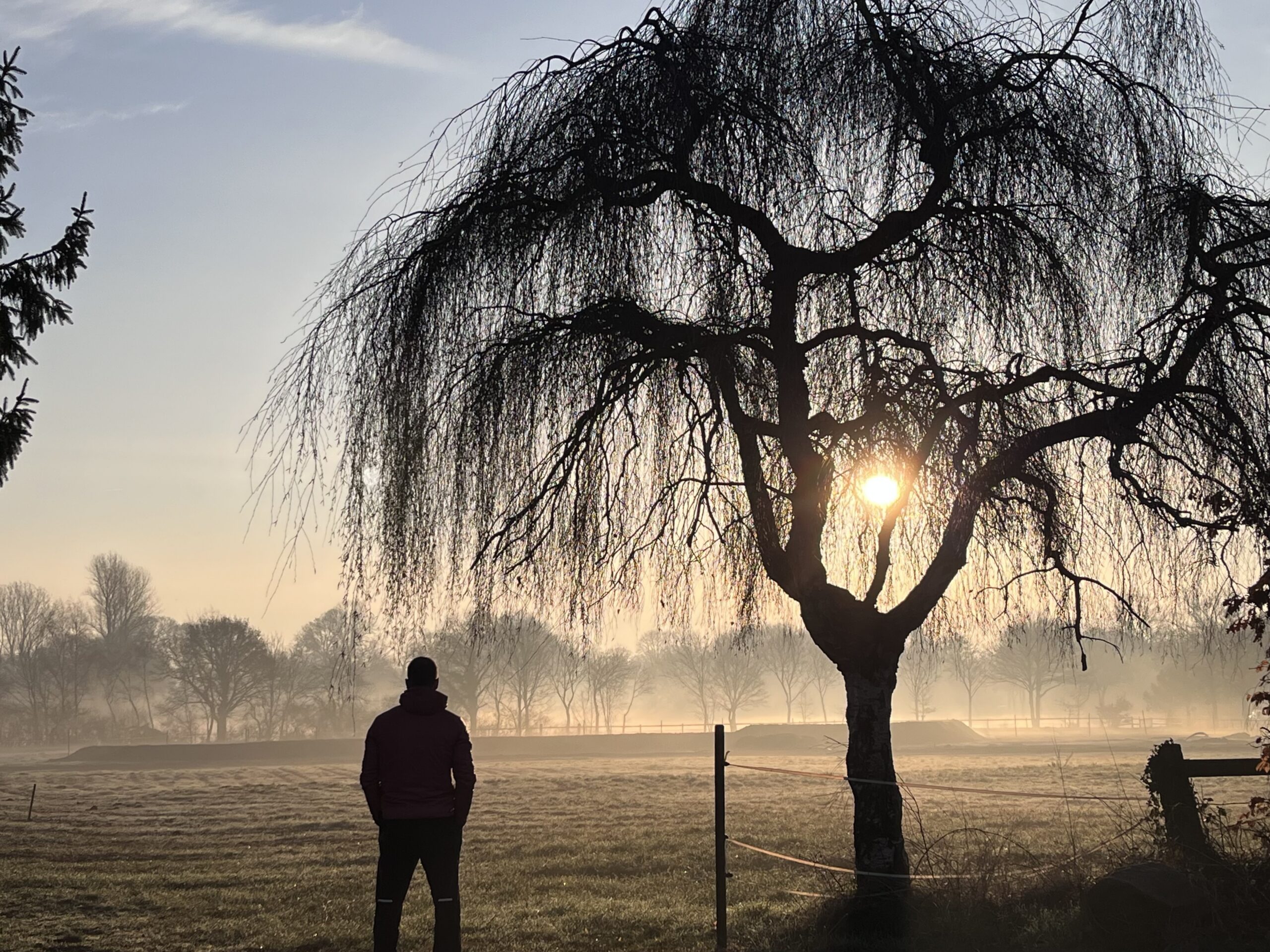
“The first sense of the ‘white page’ is what those who practice mindulness and/or meditation experience as the opening of a space inside.
And that sense of space already brings incredible benefits:
new perspectives on self and the world, a greatly increased relational capacity- I actually have room for you inside me – a huge resource of inner stillness, and much more access to the receptivity of ’the idea came to me’, i.e. higher levels of both critical and innovative thinking.”

the effects of stillness
Since more than a year I am participating in an intensive program on personal, inter-generational and collective trauma. Meditation is an essential part of the training. We are expected to daily meditate for one hour. In the beginning that didn't quite go so well, to use an understatement.
Something shifted when we had a silent meditation retreat in the beginning of March with our group of 220 participants. During the seven days we sank in stillness, slowed down and experienced profound rest. Sitting alternated with walking meditation. Eating in silence. No non verbal communication. No phone or mails. No reading or writing.
It turned out to be an interesting journey with surprising, painful and beautiful moments. What intrigued me most of all was the effect of the silence on my body and mind.
I could sense how my nervous system gradually relaxed. My sleep was deep and long. On the one hand the painful points of tension in my body melted. On the other hand some chronic pain, that I usually never feel, suddenly came to the foreground because of the deep relaxation.
It seemded as if I discovered layer after layer in myself. I encountered sensations, blockages, memories, images, inspiration.
The circumstances were very particular. We were guided online (!) by our teacher, Thomas Hübl. He was stuck in Tel Aviv because of the war. Somehow, this made our experience even more intense and relevant. The whole point of our training is precisely this:
How to stay present in the midst of chaos, threat and uncertainty?
“The white page is the source of all creativity, all new insights, all innovative thinking, the faculties so prized by most organizations and that at this time of multiple crises we need more urgently than ever.”
sitting as a remedy
Today I can still feel the inner silence. Something seems to have been softened, cleared en opened.
My resistance against meditation is diminshed. I now even look forward to sitting in the morning!
I have finally learned to see and experience meditation as simply being with what 'is'. And then you encounter all sorts of things:
To-do lists, restless legs, great ideas, daydreaming, critical voices ("You will never learn!"), a faltering breath, boredom, noises in the street, noticing you are pulling up your shoulderblades. And also moments of stillness, the warmth of your beating heart, inspiration, expansion, energy slowly moving towards the ground, feeling the ground beneath you.
For me, meditation is a remedy against the overload and intensity of the news, against too much noise, speed, agitation and superficiality.
It is slowly becoming a way to deal with the intensity and chaos in the world and the turbulence and critical crises we are experiencing as humanity.
Taking a moment in the morning to sit, brings me focus, rest, grounding and a clear mind for the day to come.

INSPIRATIon
Nicholas Janni & Amy Elizabeth Fox (2026). Leading in Chaos. LID Publishing.
(both are trained and inspired by Thomas Hübl)
Timeless Wisdom Training, Academy of Inner Science, Thomas Hübl (2025-2026)
Copyright © Silvia Prins (2026). All rights reserved.
Photos: Silvia Prins