

WORKPLACE life
If you work in an organisation, you know the drill: there is often a fair amount of ‘drama’... TV series like The Office turn out to be rather pale imitations of reality.
Here are a few examples you might recognise:
- Managers refer to their team as a “kindergarten”. Apparently, employees behave in a rather ‘childish’ way.
- Employees complain that “everyone is working in their own little silo” and that there is no longer any sense of being a team.
- Managers express their amazement at “historical conflicts” that remain unresolved, no matter what they try.
- One manager after another fails or leaves, and the position starts to resemble a revolving door.
- There are tensions within a department, and people say they feel hurt. It turns out that the pain stems from an incident that took place more than 15 years ago...
- People talk about an “inexplicable heaviness” within the organisation, as if it were embedded in the very fabric of the place...
Isolation, fragmentation, polarisation, gossip, conflicts that cannot be discussed, boundary-crossing behaviour, microaggressions, status struggles, alienation, power games... The list seems endless.
I continue to be amazed by how organisations deal with this kind of behaviour. They either try to ‘fix’ it or simply normalise it.
Organisations try all sorts of things, but more often than not, these interventions have little lasting impact (e.g. an organisational climate survey, individual coaching, a Nonviolent Communication course, moving someone to another position). Nothing really changes.

SYMPTOMATIC BEHAVIOUR
Instead of trying to ‘fix’ destructive behaviour, unhealthy situations, escalating dynamics or problematic leadership – or simply normalising them – we could look at them differently. We could see them as symptoms.
The question then becomes: symptoms of what? We could view these reactions as signposts pointing towards hidden wounds, unhealed ruptures or broken connections.
Suffering within organisations is often invisible. And yet, the organisational field contains a wealth of information that we don't readily perceive.
I love the powerful metaphor that Thomas Hübl uses in this context. It is as if painful experiences have been locked away in a room, with the lights off and the door locked. In some cases, even the door itself has become invisible. We walk down the corridor, hearing all sorts of strange noises... trauma symptoms trying to get our attention.
The collective shadow affects everyone. It drains an organisation of its vitality, creates a sense of unsafety and leads to disconnection.
These wounds remain hidden until we shine a light on them and dare to look at what is there!
TRAUMA AND RESILIENCE
The symptomatic behaviour associated with hidden pain gives rise to a particular culture: “That’s just how we do things around here!” It becomes a kind of unquestioned norm.
Rather than pointing fingers and looking for the source of discomfort somewhere outside ourselves, it is far less obvious to look at the system itself – and to recognise ourselves as part of that system.
Instead of saying “it” or “he/she” needs to change, the commitment becomes: I/we need to change.
Developing individual and collective resilience offers a pathway towards genuine change, learning and development. And resilience is NOT some ‘Kumbaya concept’! It is tough stuff.
Resilience is about our capacity to remain present in the face of tension, resistance, conflict and intense emotions – without becoming reactive or slipping into autopilot.
In that sense, trauma and resilience are two sides of the same coin.

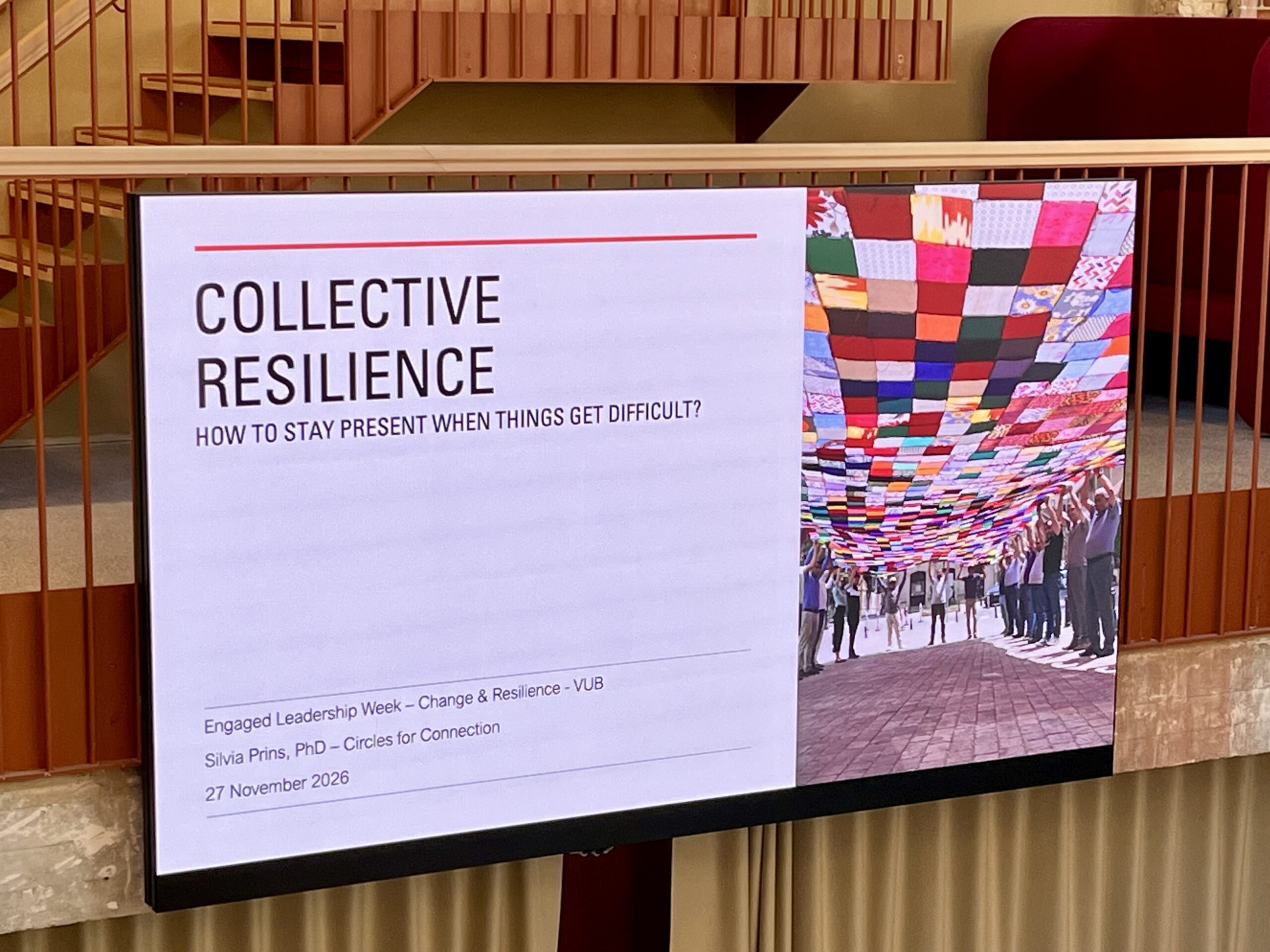
ARe your interested?
I have delivered this talk for open groups and also in-house on several occasions, in the form of a masterclass, keynote or lecture.
One example was at VUB (Vrije Universiteit Brussel), for its leadership community during the ‘Engaged Leadership Week’, under the title:
“Collective Resilience. How to Stay Present When Things Get Difficult.”
This could also be brought to your organisation!
Please contact me if you're interested.
Copyright © Silvia Prins (2026). All rights reserved.
Articles or excerpts may be republished elsewhere, provided that the copyright notice and the name of the website are clearly acknowledged. I would appreciate being informed if you do so.